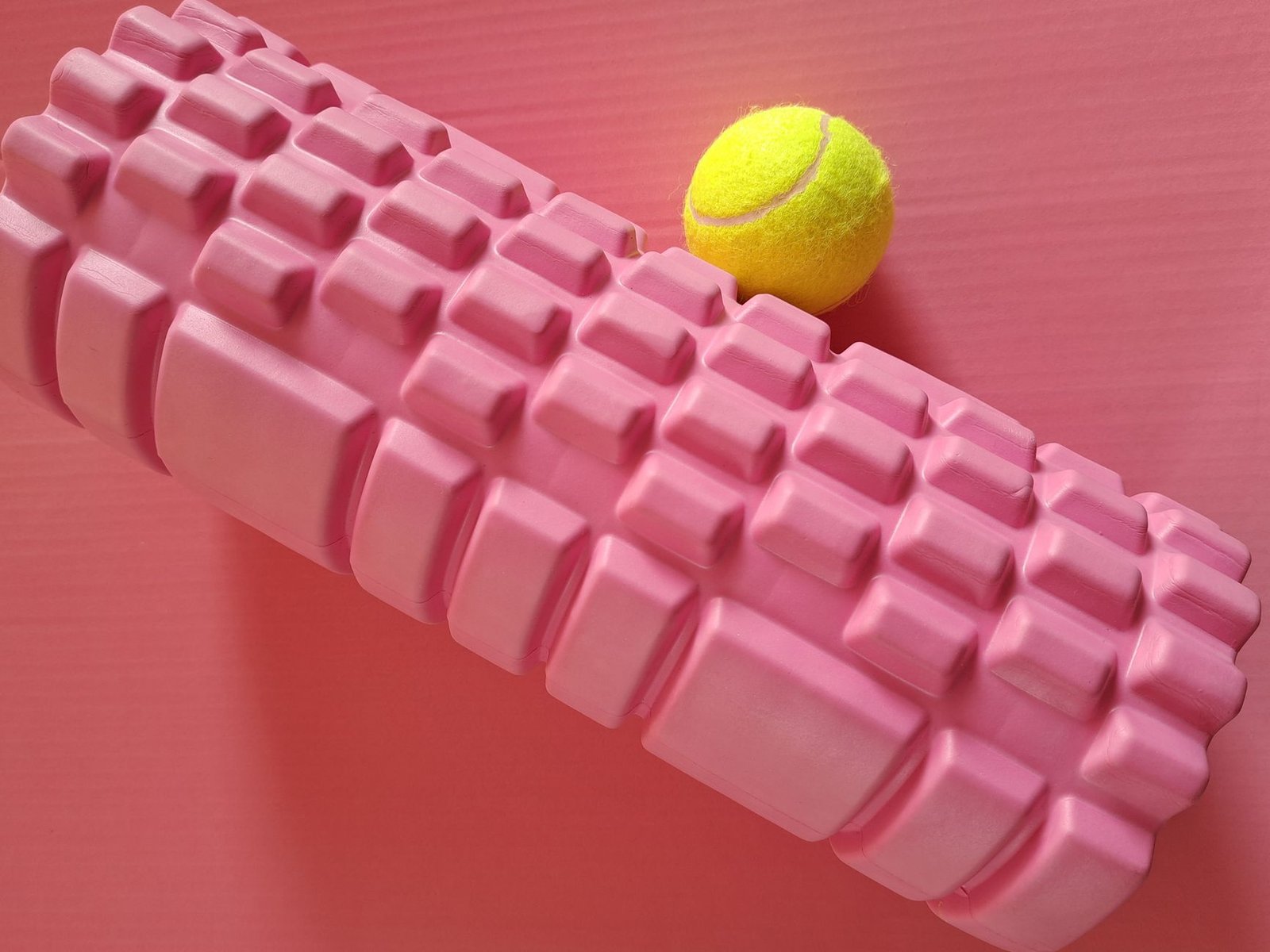
Using a foam roller should involve controlled pressure, not a test of pain tolerance. When used appropriately, it may temporarily improve range of motion and could help reduce post-exercise soreness.
Before you start
Choose a smooth, medium-density roller. Begin with more of your body supported by hands or the opposite foot. Shift less weight onto the roller if you tense up or hold your breath.
Foam rolling does not literally break knots or permanently lengthen fascia. Its effects are better understood as short-term changes in tolerance, sensation, and range of motion.
Calves
- Sit with the roller under one calf and hands behind you.
- Roll from above the Achilles tendon to below the knee.
- Turn the leg slightly inward and outward to explore the muscle.
- For more pressure, cross the other leg on top.
Avoid rolling directly on the Achilles tendon or behind the knee.
Front of the thigh
- Lie face down with the roller under one or both thighs.
- Support yourself on the forearms and keep the trunk stable.
- Roll from just above the kneecap to below the front of the hip.
- Bend and straighten the knee slowly over a tender region if comfortable.
Outer thigh
The side-lying position can be intense. Support much of your weight through your hands and top foot. Roll the lateral thigh muscle rather than grinding directly over the greater trochanter at the hip or the outside of the knee.
You do not need to ‘release the IT band.’ Use the technique for tolerable symptom relief, not as a promise to reshape dense connective tissue.
Inner thigh
- Lie face down with one knee bent to the side.
- Place the roller under the inner thigh.
- Roll slowly between the inner knee and groin, avoiding sensitive structures near both ends.
Glutes
Sit on the roller and cross one ankle over the opposite knee. Lean slightly toward the crossed-leg side and use short passes across the gluteal muscles. Use a ball against a wall if floor pressure is too difficult to control.
Upper back
- Place the roller across the mid-to-upper back, not the low back.
- Support the head with your hands and lift the hips slightly.
- Roll between the lower edge of the shoulder blades and upper thoracic area.
- For gentle extension, keep the hips down and lean over the roller without forcing the neck.
Lats
Lie partly on your side with the roller below the armpit. Reach the lower arm overhead and use short passes along the side of the upper back. Avoid direct pressure in the armpit, where nerves and blood vessels are more exposed.
When to foam roll
- Before training: 30–60 seconds on a restricted area, followed by dynamic movement and rehearsal sets.
- After training: use it for comfort; it is optional.
- On recovery days: combine a few minutes of rolling with easy movement.
A full session rarely needs to exceed 10–15 minutes.
Common mistakes
- Using pain as the measure of effectiveness
- Rolling too quickly to control pressure
- Spending several minutes on every tender spot
- Rolling directly over joints, bruises, or acute injuries
- Expecting a roller to solve a training-load problem
Who should be cautious?
Ask a qualified clinician before using a roller if you have impaired sensation, significant vascular disease, a bleeding disorder, take anticoagulants, recently had surgery, or have an undiagnosed injury. Stop for swelling, worsening pain, numbness, or unusual bruising.

Pressure matters more than pain tolerance
Good foam rolling does not require you to endure the maximum pressure possible. A roller is simply a way to apply broad pressure while you control how much body weight is placed on it. If you are grimacing, holding your breath, or tensing the entire body, reduce the pressure or choose a softer roller.
Move slowly enough to notice which areas feel sensitive, but avoid spending long periods grinding over one painful point. The aim is to make subsequent movement feel easier, not to win a contest against the roller.
Pair each area with an active movement
After rolling a region, stand up and use it. Calf rolling can be followed by ankle rocks or calf raises. Rolling the front of the thigh can be followed by a few easy squats. Upper-back rolling can be followed by controlled rotation or an overhead reach. This gives you immediate feedback on whether the technique helped.
Areas that deserve extra caution
- Avoid direct heavy pressure over joints, fresh bruises, open wounds, or areas with unexplained swelling.
- Stop if rolling creates numbness, tingling, sharp pain, or symptoms that travel down a limb.
- Be cautious around recent injuries or surgery and follow professional guidance when appropriate.
- Do not use aggressive rolling as a substitute for assessment when normal movement is clearly limited.
For most people, the simplest useful routine is brief: choose the two or three areas that actually feel relevant, roll them comfortably, then move on with the warm-up or recovery session.
Technique should change with the goal
Before training, the goal is usually to reduce the sense of restriction without making the area more sensitive. Use shorter bouts, moderate pressure, and immediately follow with active movement. On a recovery day, you can move more slowly if the pressure feels relaxing, but the same rule applies: more discomfort is not evidence of a better effect.
Common mistakes
- Rolling directly over joints instead of the surrounding muscle.
- Using so much body weight that you cannot relax or breathe normally.
- Spending several minutes on one tender spot without retesting movement.
- Using foam rolling to avoid addressing a training-load problem or persistent pain.
A roller is most useful when it improves comfort enough to help you move well. It is not necessary to “break up” tissue or chase every sensitive point.
Training note: Retest a squat, lunge, or reach after rolling. If nothing useful changes, move on instead of adding pressure.
Sources and further reading
- Foam rolling and recovery: systematic review and meta-analysis
- Foam rolling and range of motion: meta-analysis
- Myofascial rolling duration: systematic review
General self-care information only. Foam rolling is not a diagnosis or treatment for injury.
Foam Rolling Techniques: A Head-to-Toe Guide
Foam rolling should involve controlled pressure, not a test of pain tolerance. It may temporarily improve range of motion and reduce post-exercise soreness. The technique involves slow passes for 30–60 seconds per area, pausing briefly on tender points while breathing, and keeping pressure around 4–6 out of 10. It is important to stop for sharp pain, numbness, or tingling. The roller does not literally break knots or permanently lengthen fascia, but its effects are better understood as short-term changes in tolerance, sensation, and range ofmotion.
Frequently asked questions
What is the recommended technique for foam rolling the inner thigh?
The recommended technique for foam rolling the inner thigh is to lie face down with one knee bent to the side, place the roller under the inner thigh, and roll slowly between the inner knee and groin, avoiding sensitive structures near both ends. Use controlled pressure and avoid direct pressure in the armpit.
What is the best way to avoid common mistakes when foam rolling?
Avoid rolling directly over joints, use appropriate pressure, and retest movement after rolling. Also, avoid using foam rolling to address training-load problems or persistent pain.