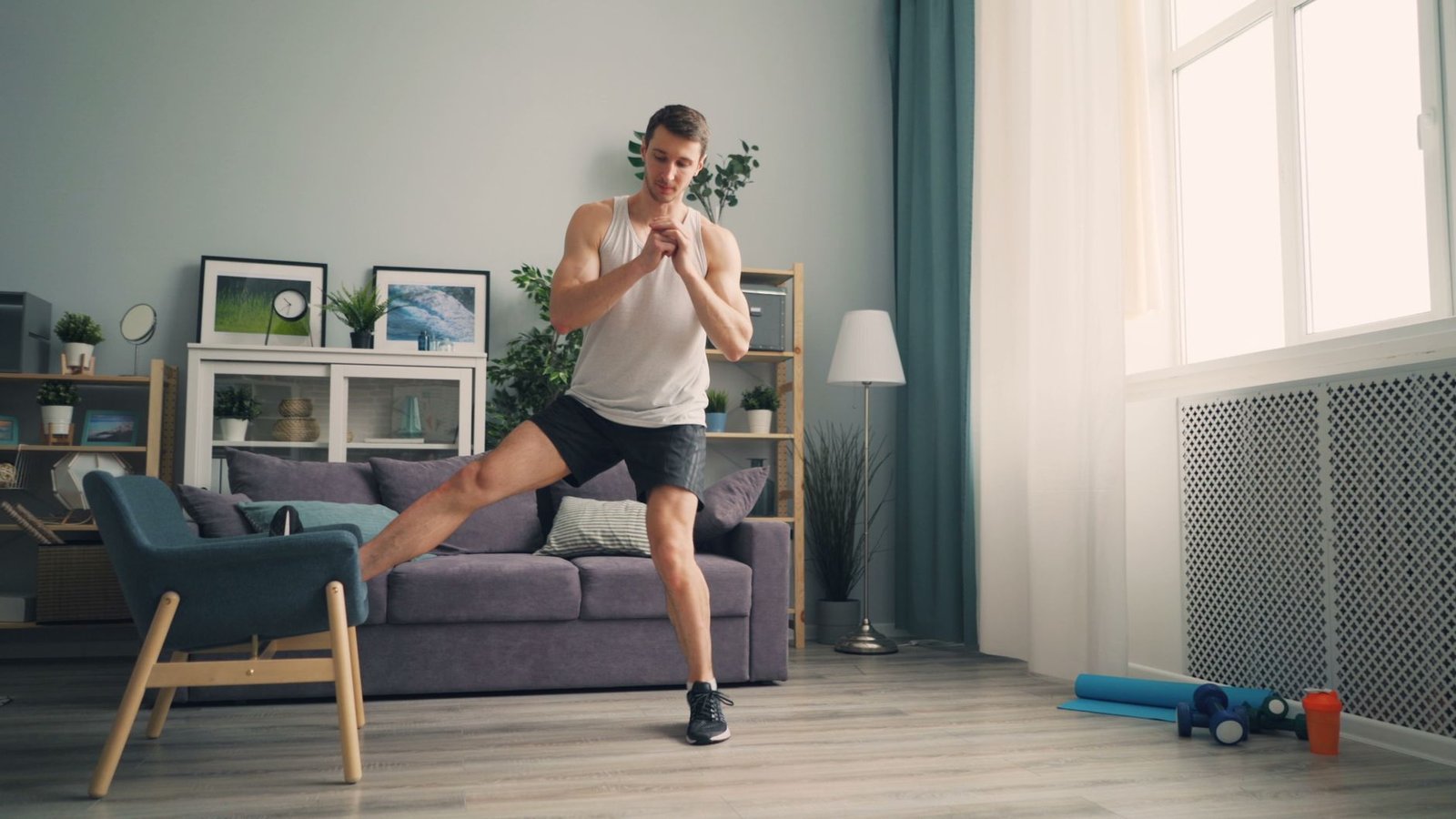
Home workouts can be deceptively demanding. High-repetition circuits, jumping, lunges, and minimal rest may create more fatigue and soreness than a short session suggests. Recovery still depends on the same fundamentals as gym training.
Why home workouts can be hard to recover from
Without heavy weights, people often add more repetitions, shorten rest periods, and take every set to failure. That creates a large fatigue cost. New exercises and eccentric movements—such as slow squats, split squats, and push-up negatives—can also produce substantial soreness.
The solution is not necessarily more recovery work. It is usually a better training dose.
Build a recoverable weekly rhythm
A simple three-day structure works well for many beginners:
- Monday: full-body strength circuit at a controlled effort
- Wednesday: mobility plus easy aerobic work
- Friday: full-body strength circuit
More experienced trainees can train more frequently by alternating movement patterns and intensity. Avoid increasing repetitions, rounds, exercise difficulty, and frequency at the same time. Change one variable, then observe how you recover.
Use effort, not exhaustion, to guide sets
Stop most strength sets when you believe you could perform another two or three clean repetitions. This “repetitions in reserve” approach creates a useful training stimulus without turning every session into a test.
If technique changes, range of motion shrinks, or you need to hold your breath excessively to finish, the set has probably gone far enough.
Your home recovery kit can be simple
- A water bottle
- A mat or comfortable floor space
- A resistance band for light movement and strength work
- A foam roller or ball if you enjoy self-massage
You do not need compression boots, electrical stimulation, or a massage gun to make progress. Those tools may affect comfort, but the return on sleep, food, and good programming is larger.
A 12-minute recovery session
Use this on an easy day or after hours of sitting. None of the movements should feel like hard training.
- Easy marching or walking — 3 minutes: breathe through your nose if comfortable.
- Cat-camel — 6 slow repetitions: move gently through the spine.
- 90/90 hip switches — 6 per side: use your hands for support.
- Half-kneeling hip flexor rocks — 8 per side: keep ribs stacked over the pelvis.
- Open books — 6 per side: rotate through a comfortable upper-body range.
- Bodyweight squat to a chair — 8 repetitions: easy tempo, no grinding.
- Relaxed breathing — 2 minutes: allow the exhale to lengthen naturally.
If you want a longer movement plan, use our mobility recovery session.
Eat and sleep for the work you are doing
Aim for regular meals that contain a meaningful protein source. Healthy exercising adults often use 1.4–2.0 g of protein per kilogram of body weight per day as a practical range. You do not need supplements if ordinary food meets your needs.
Adults typically need seven to nine hours of sleep. If you train late and feel alert afterward, finish intense exercise earlier when possible, include a short downshift, and keep caffeine away from the latter part of the day.
What to do when you are sore
Mild muscle soreness often improves with easy movement. Reduce the range, load, or repetitions if soreness alters technique. Training a different movement pattern may be reasonable; repeating the same high-volume session usually is not.
Sharp, localized, or worsening pain—especially around a joint—deserves more caution than ordinary symmetrical muscle tenderness.

Home training can be deceptively hard to recover from
Training at home does not automatically mean the workload is light. High-repetition bodyweight sessions, repeated jumping, slow-tempo sets, and circuits taken close to failure can create substantial fatigue even without heavy weights. The recovery demand comes from what your body did, not from whether the session happened in a gym.
This matters because home workouts are easy to repeat frequently. When equipment is always available, a planned rest day can become another “quick” circuit. If the same muscles and movement patterns are trained hard every day, performance can gradually flatten even though each individual session looks simple.
Build recovery into the weekly plan
A practical home program alternates stress instead of relying on recovery gadgets afterwards. Hard lower-body work can be followed by easier upper-body training, mobility, walking, or rest. Conditioning can vary between demanding intervals and genuinely easy aerobic movement.
- Keep at least some sessions clearly easier than your hardest days.
- Track a few repeatable exercises so you can notice whether performance is improving or slipping.
- Use soreness as information, not as the only reason to train or rest.
- Increase volume gradually when you add new movements or slower tempos.
What you actually need at home
You do not need a collection of recovery products. Space to walk, a regular sleep routine, enough food, and a training plan you can sustain cover most of the basics. A foam roller, band, or massage tool is optional if it makes movement more comfortable, but it should solve a specific problem rather than create another routine you feel obliged to complete.
Track effort even when you train without weights
One reason home programs become difficult to recover from is that intensity is harder to see. A barbell tells you how much load is on it; a set of push-ups or split squats can quietly become much harder when you add repetitions, slow the tempo, shorten rest, or train closer to failure.
Use a simple effort scale. Most repeatable home strength work should finish with a few technically good repetitions still available. Save true all-out sets for occasional testing rather than making every session a test.
A sustainable weekly rhythm
- Two or three harder sessions with a clear training goal.
- One or two easier sessions focused on technique, mobility, or aerobic work.
- At least one day where you do not feel obligated to “make up” missed volume.
This approach gives you more room to progress than stacking hard circuits simply because they require little equipment.
Training note: Home training is still training. Treat volume, proximity to failure, and progression with the same respect you would give a loaded gym session.
Sources and further reading
- World Health Organization: physical activity
- Protein and exercise position stand
- Sleep loss and exercise performance
Choose movements that suit your health and ability. Seek professional assessment for injury symptoms or persistent pain.
Frequently asked questions
How gentle should a recovery mobility session feel?
Keep the session comfortable enough that it does not create a new training cost. Use relaxed repetitions, smaller ranges when needed, and stop short of fatigue. If movement gradually feels smoother, continue. If soreness becomes sharper, your range decreases, or you feel progressively more tired, shorten the session or choose simple rest instead.
Should I push deeper stretches when I feel stiff?
No. A recovery day is not a flexibility test. Use comfortable motion rather than chasing your deepest position or long, intense stretches. The session should leave movement feeling easier, not create a local pump or more fatigue. Save demanding end-range work for sessions where flexibility or strength at long muscle lengths is the actual training goal.